public repositories · open source tools

heres the stuff. heres what it does. heres how to get started.

hydra leads. one engine as a prompt, a terminal agent, a swarm, a local gateway, and a daemon working on alice. easylm.app is the in-browser workstation. the other repositories stay on the shelf. dadavol1 is the field manual for working alone with an agent.

scroll to hydra

01 · the stuff : hydra, easylm, then the shelf

01 · hydra

sovereign multi-headed ai engine · interactive tui agent · model gateway router
v1.2.1 release Python 3.8+ & Node 18+ Open Source · Apache-2.0 Zero External Dependencies Dual Runtime Parity Interactive TUI Agent OpenAI Server Port 7777 Autonomous Swarms MCP & Native Tools

Same engine, several working forms: a one-shot prompt, the interactive TUI agent, a swarm, the local gateway, and a background orchestrator daemon. A daemon is running now and using Hydra to work on Alice. That daily use is why Hydra leads this page.

hydra system execution genome · progen iron
scope : sovereign multi-headed command-line AI engine and model router.
runtime zero : identical standard library Python and Node runtimes with zero external dependencies.
gateway socket : OpenAI-compatible HTTP gateway on 127.0.0.1 port 7777.
terminal interface : inline prompt_toolkit TUI composer pinned beneath terminal scrollback with in-flight steering.
routing cascade : OpenRouter to Vercel AI Gateway to Cloudflare Workers AI to CheaperInference.
cognitive engine : Snowgate Alice proposition evaluation prior to remote model generation.
truth : exit code zero passing; unverified assertion carries zero truth value.

six core functions for sovereign model summoning and terminal automation

01

multi-model routing

Dispatches queries across frontier models, free cloud endpoints, and offline local daemons using single clean aliases like hydra sonnet 5.5, hydra opus 5.5 high, or hydra sol 6.1 pro. An automated cascade queries OpenRouter first, falls back to Vercel AI Gateway, and descends to Cloudflare Workers AI, redacting credentials and paths from error records.

02

prompt execution

Executes single queries with real-time SSE token streaming, test-time compute controls like --effort high or --reasoning-mode pro, and structured --json output. Deep Unix pipe support enables cat file.py | hydra <alias> to treat stdin as the prompt, or pair stdin with instructions via cat log.txt | hydra sol 6.1 - "audit errors".

03

interactive tui terminal mode

Launches a persistent coding agent REPL via hydra agent or -i. The composer stays pinned beneath native terminal scrollback and shows the active model, working directory, detected rules, and session id. Ctrl+Space dictates. Enter sends. A second Enter steers a running turn. Ctrl+C interrupts. Slash opens commands, and a context gauge tracks the window.

04

continuous swarms

Orchestrates multi-agent specialist teams via hydra swarm. Runs Architect and Coder heads in parallel, triggers an ordered Auditor head post-generation to inspect code patches, and finishes with a Synthesizer head delivering a unified consensus roadmap. Swarms support autonomous tool execution through the --agentic flag.

05

background orchestrator daemon

Powers unattended long-horizon workflows and task intake via hydra orchestrator and idle compute worker scripts. Executes overnight repository audits, continuous research loops, automated test passes, and session context ledger persistence without human intervention. A daemon is running now and using Hydra to work on Alice.

06

openai api server on port 7777

Hosts a zero-dependency OpenAI-compatible gateway on 127.0.0.1:7777 via hydra serve. Provides standard /v1/models and /v1/chat/completions endpoints with transparent alias resolution, provider failover, streaming token chunks, and tool calling passthrough for external runners like Hermes and Pi.

ten interconnected model providers, inference engines, and cognitive runners

Claude Opus 5.5 & Sonnet 5.5 Anthropic

Frontier reasoning and surgical code crafting. Direct alias summoning with configurable reasoning effort tiers from low to max.

GPT-6.1 Sol OpenAI

Flagship OpenAI reasoning with pro mode and high reasoning effort for formal invariant verification, security audits, and adversarial code reviews.

Cloudflare Workers AI Zero-Cost Tier

Powers hydra free at zero marginal cost using Meta Llama 3.3 70B Instruct fast running on global Cloudflare edge hardware.

OpenRouter Free Forge & Frontier Aggregator

Primary frontier router and secondary zero-cost fallback querying open-access Gemma 4 and Nemotron models when cloud quotas exhaust.

Vercel AI Gateway Edge Gateway

High-throughput, low-latency edge routing layer providing automated failover routing for production agent pipelines.

Hugging Face Serverless Inference API

Direct serverless inference routing via hydra hf targeting open-weight model endpoints without dedicated infrastructure.

CheaperInference Discount Tier

Discounted frontier inference access and specialized GLM-5.3 models delivering budget efficiency on high-volume batch jobs.

Local Ollama & llama.cpp Offline Local

Offline execution through hydra local connecting to Ollama, llama.cpp, or EasyLM HTTP sockets with zero internet data transfer.

Snowgate Alice Cognitive Engine Cognitive Core

Evaluates input queries through native Alice proposition parsing and deterministic tool pipelines before remote model generation begins.

MCP Ecosystem & Native Tools Tool Protocol

Built-in stdio JSON-RPC 2.0 client connecting Filesystem, Fetch, SQLite, Git, GitHub, Brave Search, Memory, and Playwright, paired with nine zero-dependency native coding tools.

five structural advantages of sovereign multi-headed routing

01

sovereign local data privacy

Zero third-party telemetry, tracking daemons, or background data collection. Prompts and tokens stay strictly on local hardware during offline inference. Child MCP processes run with stripped environments to prevent API token leakage.

02

compute tiering economics

Minimizes token spend by routing mechanical transforms, syntax linting, and directory navigation to free cloud tiers or local hardware. High-cost frontier tokens activate strictly when formal reasoning and architectural auditing demand them.

03

cross-model consensus verification

Eliminates single-model blind spots. Multi-agent swarms pit independent model families against each other, verifying code patches and system designs through adversarial auditing and automated synthesis.

04

zero vendor lock-in

Pure Python standard library and Node standard library implementations with zero external dependencies. Swapping upstream providers or switching models requires zero code refactoring.

05

offline fallback

Unbroken productivity during network outages or air-gapped field operations. When internet connectivity drops, commands route immediately to local model backends without crashing active workflows.

five practical workflows for autonomous engineering and research

SWARMS

autonomous coding swarms

Multi-headed parallel refactoring where Opus models system architecture, Sonnet writes production code and tests, GPT-6.1 Sol audits security vulnerabilities, and Gemini synthesizes the verified release.

DAEMONS

continuous overnight research daemons

Background orchestrator loops that poll technical feeds, ingest academic papers, parse propositions through Snowgate Alice, and generate structured markdown digests while you sleep.

PIPELINES

terminal workflow automation

Seamless command-line pipes where compiler errors, test failure traces, git diffs, and server logs stream directly into reasoning models for immediate root-cause diagnostics.

AUDITING

multi-model code review and refactoring

Pairing disparate model architectures to evaluate pull requests, ensuring that architectural invariants and boundary conditions face independent verification before merging.

GRAPHS

deterministic knowledge graph ingestion

Extracting propositions from raw documentation through Alice cognitive grammar and recording structured entities directly into MCP Memory graphs or local SQLite stores.

terminal agent view pinned beneath native scrollback
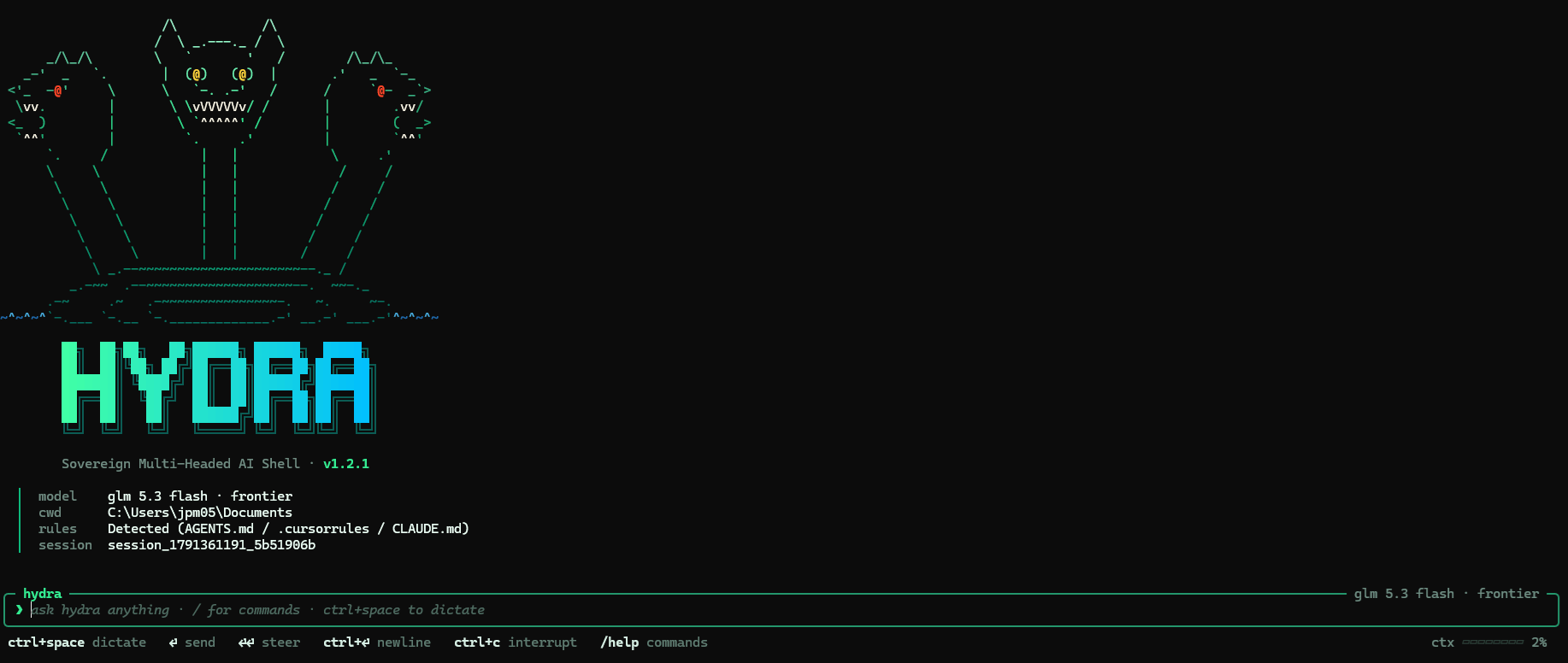
Hydra v1.2.1 idle composer with the three-headed mark, model line, working directory, detected rules, session id, pinned prompt, and context gauge.

Current idle composer. The mark, model, directory, detected rules, and session sit above the pinned prompt. Ctrl+Space dictates. Enter sends. A second Enter steers a running turn. Slash opens commands.

copy-ready terminal commands and programmatic sdk examples

bash / powershell · frontier model summoning
# summon claude sonnet 5.5 with default streaming:
$ hydra sonnet 5.5 "Implement a zero-copy ring buffer in Rust"

# summon claude opus 5.5 with high reasoning effort:
$ hydra opus 5.5 high "Verify distributed raft state machine invariants"

# summon gpt-6.1 sol with pro reasoning mode:
$ hydra sol 6.1 pro "Audit authentication token validation logic for side channels"

# pipe source code directly into model with trailing instruction:
$ cat src/parser.c | hydra sonnet 5.5 - "Identify potential memory leaks"
bash / powershell · interactive tui agent
# launch interactive coding agent repl pinned beneath scrollback:
$ hydra agent

# launch with interactive in-flight tool confirmation:
$ hydra agent --steer

# run single autonomous agent task with native file and bash tools:
$ hydra agent "Inspect pyproject.toml and add coverage scripts"

# summon specific model with model context protocol tools enabled:
$ hydra sonnet 5.5 --mcp "Search sqlite database for stale sessions"
bash / powershell · multi-agent swarms
# fan out across default architect, coder, auditor, and synthesizer heads:
$ hydra swarm "Design and test an async event dispatcher"

# delegate specialist heads to hermes and pi cli binaries:
$ hydra swarm "Refactor parser" --heads architect:hermes,coder:pi,auditor

# enable autonomous tool-augmented execution loops across swarm heads:
$ hydra swarm "Fix security vulnerabilities" --agentic
bash / powershell · openai-compatible gateway server
# 1. launch sovereign openai gateway on port 7777:
$ hydra serve --port 7777

# 2. point external agents like hermes, pi, goose, or aider to hydra:
$ export OPENAI_BASE_URL="http://127.0.0.1:7777/v1"
$ export OPENAI_API_KEY="sovereign-hydra"

# 3. list registered models and aliases:
$ curl http://127.0.0.1:7777/v1/models

# 4. send chat completion with automatic alias resolution:
$ curl http://127.0.0.1:7777/v1/chat/completions \
    -H "Content-Type: application/json" \
    -d '{"model":"sonnet 5.5","messages":[{"role":"user","content":"ping"}]}'
bash / powershell · free tier & offline local inference
# zero-cost cloud inference via cloudflare / openrouter free forge:
$ hydra free "Explain the Byzantine Generals problem"

# completely offline local inference via ollama / llama.cpp:
$ hydra local "Write a unit test for email validation"

# hugging face serverless inference routing:
$ hydra hf "Summarize git log output"

# zero-cost agent loop with native file and bash tools:
$ hydra agent --free "Lint repository python files"

# offline local agent loop with no external network calls:
$ hydra agent --local "Format markdown files"
bash / powershell · model context protocol
# initialize default community mcp servers template in ~/.hydra:
$ hydra mcp init

# inspect registered mcp servers and exposed tools:
$ hydra mcp list

# test connection and tool discovery on filesystem server:
$ hydra mcp test filesystem

# test web fetch server:
$ hydra mcp test fetch

# summon model with live brave search mcp tool:
$ hydra sonnet 5.5 --mcp "Search brave for latest rust release notes"
python & node.js · programmatic integration
# python standard library programmatic invocation:
from hydra_cli import complete, run_agent_loop, McpRegistry

# direct synchronous prompt completion:
response = complete("sonnet 5.5", "Explain memory barriers")
print(response)

# autonomous tool-augmented agent loop:
registry = McpRegistry()
result = run_agent_loop("opus 5.5 high", "Audit codebase", registry=registry)
registry.shutdown()
print(result)

install python and node packages with zero external dependencies

bash / powershell · install commands
# python global or virtualenv install from git:
$ pip install "git+https://github.com/erastudil/hydra.git"

# or node global cli install:
$ npm install -g "git+https://github.com/erastudil/hydra.git"

# direct linux / macos bootstrap script:
$ curl -fsSL https://raw.githubusercontent.com/erastudil/hydra/main/install.sh | bash

# direct windows powershell bootstrap script:
PS> irm https://raw.githubusercontent.com/erastudil/hydra/main/install.ps1 | iex

source: github.com/erastudil/hydra · packages: hydra-ai-cli · hydra-agent-cli

02 · easylm.app

in-browser workstation · chat, studio, learn, stacks, personalities, kid safe
Live at easylm.app Open Source · AGPL-3.0 WebGPU In-Browser Chat · Studio · Learn 31 Dewey Stacks 8 Courses Kid Safe Profile

Four tabs on one local machine: Chat, Studio, Learn, and Options. Weights download once into browser cache and run on your GPU through WebGPU. Prompts, course progress, and profile memory stay on the device. The model, the textbook, and the homework coach share one profile, so a chapter, a graph, and a chat thread are the same session.

easylm workstation contract · local only
scope : in-browser WebGPU workstation for chat, study, and making.
tabs : Chat, Studio, Learn, Options.
weights : cached once in the browser, then inference stays on the local GPU.
memory : AtMem atoms scored into a 256-token envelope, with an optional AES-GCM-256 vault.
stacks : 31 Dewey textbooks, each with a link index of official sources.
learn : eight courses, a today plan, a lesson walk, Leitner cards, and a progress record.
kid safe : separate Student profile, parental PIN, Homework Coach, web tools off, model allowlist.

six parts of one local session

01

chat

The thread runs an open-weight model on the GPU you already have. Qwen 2.5, Llama 3.2, Llama 3.1 8B, Gemma 2, Gemma 3, Mistral 7B, Phi-3.5, DeepSeek-R1 distill, and Qwen 2.5 Coder are in the picker, plus the EasyLM Hands adapters and the Alice EMap adapter. AtMem keeps a notebook per profile and injects only the atoms that fit a 256-token envelope, so memory helps the reply without eating the whole context. A note can move into Studio, and a Studio result can come back into the thread.

02

studio

Five offline tools sit beside the model: Read, Write, Code, Graph, and Draw. Read opens a Stacks chapter and the official doors for that pack. Write drafts markdown and exports Word, PDF, or LaTeX, and a markdown table can leave as CSV. Code runs JavaScript in a page worker with a live console. Graph plots a function and can show the derivative, the roots, and an integral. Draw is a canvas. Any of those can open in Write or drop back into Chat.

03

learn

Eight courses: Scientific Inquiry, Calculus, Physics, Chemistry, Biology, Civics, Health Sciences, and Philosophy. Catalog is the shelf. Walk is the lesson. Today is the plan for this calendar day. Cards are Leitner reviews, and a missed question becomes a card. Record is the progress ledger. A lesson can open the matching chapter in Studio, so the explanation and the tool stay in one profile.

04

the stacks

31 Dewey packs from scientific method through geography. Each pack is a textbook plus a link index of official sources. Computing, software, security, mathematics, trades, literature, civics, health, and the Tao Te Ching share the shelf. Search returns the chapter. A miss says so. Some packs declare a floor age, so a younger reader stays on the chapters written for that floor.

05

personalities

Perspectives and author voices shape the reply. The gallery covers practical coaches, philosophy, science, classic authors, literary characters, and clinical counseling. Search by name, era, or book. A custom voice imports and exports as JSON. The Student profile locks the gallery to the Kids and Homework Coach, so an adult author voice cannot be selected from that account.

06

kid safe

The Student profile is a separate local account. A parental PIN is required to leave it. The Homework Coach is instructed to ask for the next step and withhold the final answer. Web fetch and web search stay off. A sentinel blocks phone numbers, home addresses, school names, and email in the prompt. The model list is an allowlist. SmolLM2 360M stays off it after it failed the kid-safe checks. A disallowed pick falls back to Llama 3.2 1B.

read, write, code, graph, and draw without leaving the profile

read

read

Opens a Stacks textbook by chapter. The link index sits with the chapter, so a claim can be checked against the official door instead of a pasted dump. Send the chapter into Write when you want notes, or back into Chat when you want the model to work from that text.

write

write

A markdown desk for the thing you are making: a problem set, a lab note, a short paper. Export Word, PDF, or LaTeX from the same buffer. If the buffer holds a table, that table can leave as CSV. The draft stays in the browser with the rest of the profile.

code

code

A JavaScript sandbox with presets for common drills, including a Monte Carlo estimate, a Fibonacci sequence, and a quadratic solver. Run prints to a console in the page. The snippet can move into Write or into the chat thread.

graph

graph

Plot a function of x. The same tool can mark the derivative, the roots, the extrema, and a numeric integral, and it can print a table of values. A calculus lesson can open here without a second app and without sending the expression to a server.

draw

draw

A canvas for a diagram, a sketch of a mechanism, or a figure you want next to the writing. The drawing can open in Write or return to Chat, so the picture and the explanation stay in one session.

opt

options

Context length runs from 8k through 256k. The hardware probe reads the GPU and can recommend a model that fits. The vault is optional AES-GCM-256 over conversations and sovereign memory, unlocked by a PIN or password you set. Profiles, the parental PIN, and the active personality live here too.

what actually loads on the machine

Qwen 2.5 and the Hands adapters Default shelf

Qwen 2.5 Instruct at 1.5B, 3B, and 7B, plus Qwen 2.5 Coder 7B. EasyLM Hands ships 0.5B and 3B adapters on the same family. The 3B Instruct build is the everyday default.

Llama, Gemma, Mistral, Phi Open weights

Llama 3.2 at 1B and 3B, Llama 3.1 8B, Gemma 2 at 2B and 9B, Gemma 3 12B Thinking, Mistral 7B Instruct, and Phi-3.5 Mini. The picker shows a VRAM estimate so the choice matches the GPU.

DeepSeek-R1 distill Reasoning

Distilled Qwen builds at 1.5B and 7B for a longer chain of thought when the question is a proof, a mechanism, or a multi-step problem.

Alice EMap adapter Local adapter

A 3B adapter on Qwen 2.5 for Alice-style proposition work, still executed in the browser. No separate cloud account.

Eight courses Learn

Scientific Inquiry, Calculus I, Physics I, Chemistry I, Biology I, Civics I, Health Sciences I, and Philosophy I. Each course has lessons, checks, a today queue, and spaced cards.

31 Dewey stacks The shelf

Methods, computing, software, security, mathematics, physics, chemistry, biology, health, engineering, trades, civics, law, literature, poetry, history, geography, and the Tao Te Ching, among the full set. Textbook plus official doors.

five reasons the study hall is on your GPU

01

the weights and the chats stay here

Inference runs through WebGPU in the browser. After the download, prompts and tokens do not need a remote API. There is no account to create and no monthly seat.

02

one profile holds the work

Chat memory, course progress, the today plan, and the studio draft belong to the same local profile. You do not copy a chapter into a second product to keep studying.

03

kid safe is a lock, not a tone

The Student account changes the model list, the voice, and the tools. Web search stays off. Leaving the account takes the parental PIN. The coach is told to withhold the final homework answer.

04

the book and the tool are adjacent

A lesson can open the chapter. The chapter can open the graph, the editor, or the draft. The official link index stays next to the paragraph you are reading.

05

offline after the cache fills

The first visit downloads the chosen weights into browser cache. Later sessions run from that cache, including a machine with no network.

five ways the workstation gets used

HOMEWORK

a student night with the pin on

Switch to the Student profile. The Homework Coach asks for the next step. Fetch and search stay off. The sentinel stops a phone number, an address, a school name, or an email from going into the prompt.

CALCULUS

a lesson that opens the graph

Walk through Calculus I. Today shows what is due. A miss becomes a card. The same session can plot the function, mark roots, and drop the figure into Write.

READING

a chapter, then a draft

Open a Stacks pack in Read. Follow the official door if a number matters. Send the chapter into Write and keep the draft on the machine.

FAMILY

two people, two memories

Parent and Student are separate local accounts on one browser. AtMem, personality, and course progress do not mix. The parental PIN is what stands between them.

OFFLINE

study after the weights are cached

Pick a model that fits the GPU, let the cache fill, then close the network. Chat, Learn, and Studio keep working from local storage and the cached weights.

open the app, or clone and run the tests

Open the live app in a WebGPU browser, or clone and run the tests locally:

bash
# 1. run immediately via web browser:
# navigate to https://easylm.app

# 2. or clone and run locally:
$ git clone https://github.com/erastudil/easylm.git
$ cd easylm
$ npm install
$ npm test
$ npm run dev

web app: easylm.app · repo: github.com/erastudil/easylm

03 · progen

topic-comment dialect and structured think traces for agents
Python 3.10+ Open Source · AGPL-3.0 Standard Library Only Deterministic Grammar Offline CLI Tools

Applies Japanese topic-comment grammar structure under English vocabulary. Cuts token costs and removes discursive filler, polite padding, and unsolicited trailing questions from model outputs and reasoning traces.

  • Topic-Comment Grammar: Every operational statement asserts topic : comment per line. Statements declare raw predicates directly with zero filler verbs.
  • Iron vs Slack Boundary: agent iron requires strict topic-comment structure for internal reasoning and execution; human slack allows informal, natural human prompts.
  • Canonical State Vectors: Declares operational intent using canonical heads: intention, requirement, course of action, end result, demand, and compliance.
  • Deterministic Truth: Exit code zero is passing. Blocked execution emits ERROR. An unverified or empty check emits DONT_KNOW.
  • Offline Tooling: Python CLI utilities to parse topic-comment units into structured JSON, lint outputs against grammar anti-patterns, rewrite text into iron, and emit reference prompts.

Requires Python 3.10+. Standard library only, zero third-party dependencies:

bash
# clone and install in editable mode:
$ git clone https://github.com/erastudil/progen.git
$ cd progen
$ pip install -e .

# run language conformance self-check:
$ progen check

# lint agent output against topic-comment grammar:
$ progen lint examples/iron.md --role agent

# rewrite conversational prose into topic-comment iron:
$ progen iron examples/mush.md

# emit reference genome prompt:
$ progen prompt genome

source: github.com/erastudil/progen

04 · zcabs

zero context agent behavioral scaffolding & proof of execution
Python 3.10+ Open Source · AGPL-3.0 Standard Library Only Fail-Closed Invariant Canary Scaffolding

Language models interpolate conversation history. An agent can claim test suites passed without executing a single command. zcabs turns execution verification into a physical file observation so that proof costs real computational work.

  • Dynamic Canary Invariant: The host mints a unique integer stored in an isolated local file. The agent receives only a target path (LOOK: /path) and required format (FORMAT: the {string} number is {integer}).
  • Unfakable Proof: To prove completion, the model must read the target file from disk and report the live integer. Guessing, static scraping, or reading an empty path fails closed.
  • Command Wrapping: zcabs wrap -- pytest -q executes any shell command. On exit code zero, it rotates the canary capability and emits the verification header.
  • Repository Scanning: zcabs scan . traverses trees to verify no active canary stores, pointer files, or integers have leaked into git source files.
  • Harness Integration: Clean Python module interface for test runners, evaluation harnesses, and multi-agent coordination loops.

Requires Python 3.10+. Standard library only, zero third-party dependencies:

bash
# clone and install in editable mode:
$ git clone https://github.com/erastudil/zcabs.git
$ cd zcabs
$ pip install -e .

# run protocol self-check:
$ zcabs check

# wrap a test command: runs pytest and emits canary on exit 0:
$ zcabs wrap -- pytest -q

# scan repository to detect leaked store integers:
$ zcabs scan .

source: github.com/erastudil/zcabs

05 · gfc

greene feynman clarity writing standard & prose linter
Python 3.10+ Open Source · AGPL-3.0 Standard Library Only Prose & Educate Modes Anti-Tell Linter

Named in honor of physicists Brian Greene and Richard Feynman. Codifies their shared pedagogical order: present the physical intuition and working mechanism first, then introduce the technical name as recognition. Includes offline tools to catch AI writing tells.

  • Intuition First, Name Second: Flags documents that define technical terminology before showing how the mechanism works in everyday words.
  • Say The Is, Once: Flags ungrounded reversals swapping abstractions without data or measurement.
  • Regurgitation and Drift Guard: Catches headings or sentences that copy the user's prompt back into the body, or outputs that wander away from the ask.
  • Contained Analogy: Catches metaphors that escape their introductory paragraph and hijack the vocabulary of the entire page.
  • Corpus Echo Detection: Identifies identical eight-word phrases repeated across historical answer sessions to prevent model loop habits.
  • Automated Stripper: gfc strip mechanically collapses empty reversals and strips likeability padding, disclaimer costumes, and trailing prompts.

Requires Python 3.10+. Standard library only, zero third-party dependencies:

bash
# clone and install in editable mode:
$ git clone https://github.com/erastudil/gfc.git
$ cd gfc
$ pip install -e .

# run test suite and fixtures:
$ gfc check

# lint human-facing markdown documentation:
$ gfc lint docs/

# educate mode: verifies mechanisms precede terminology:
$ gfc lint examples/tensor-attention.md --mode educate

# strip conversational padding and empty reversals:
$ gfc strip draft.md

source: github.com/erastudil/gfc

06 · tankbench

defensive hardening and security refactoring benchmark for coding agents
Python 3.10+ Open Source · AGPL-3.0 Triad Scoring Standard DADA Vol 1 Armory SWE-bench Export

Evaluates coding agents on defensive refactoring and security hardening of existing legacy codebases. Hands the agent Harbor Ledger 2.4: a functioning invoicing web application full of lying comments, decoy files, and 24 obfuscated security vulnerabilities.

  • Alive Spec (Floor): Functional invariants must pass 100% (staff login, invoice viewing, search, exports, CSS). Dodging attacks by deleting routes scores an immediate 0.0.
  • Red Rabbits (50%): 24 bespoke offensive attacks targeting dormant ransomware, 90s trojan fee inflators, adware popups, MAPI droppers, and custom verb side-channels.
  • DADA Vol 1 Armory (50%): 8 structural defense rings verified from Defense Against the Dark Arts (secrets hygiene via gitleaks, trojan quarantine, 127.0.0.1 socket isolation, Presidio egress PII DLP filters, and strict CSP headers).
  • Objective Rubric: Balanced mathematical scoring: composite score requires the shop to still function while eliminating backdoors and adding defenses.
  • Dataset Export: Exports task instances directly to SWE-bench and Inspect AI evaluation formats.

Zero setup required. Run baseline calibration or grade a patch:

bash
# clone benchmark repository:
$ git clone https://github.com/erastudil/tankbench.git
$ cd tankbench

# verify baseline calibration (alive pass, probes hit -> score 0.0):
$ python run.py baseline

# grade an agent solution patch file:
$ python run.py grade --patch solution.patch

# generate interactive visual html report:
$ python run.py report --overlay fixtures/hardened --open

# export benchmark dataset for swe-bench / inspect ai:
$ python run.py export --format swe-bench --out task_swe.json

source: github.com/erastudil/tankbench · armory: dadavol1.vercel.app

field manual · dadavol1

defense against the dark arts for solo agentic developers
Field Manual Solo Agentic Practice White Hat

Practical defense for one person running coding agents, including overnight daemons. Bound the checkout, the token, and the merge. The same manual is plain text at llms.txt and agent.txt.

02 · credits : standing on shoulders

credits : upstream open source & foundations

trademarks and logos belong to their respective authors. we acknowledge and salute the open-source engines, compilers, platforms, and open-weight models that make sovereign computing possible.

03 · fuel : support open source development

donations : voluntary fuel

all software authored here is released under free, permissive, or copyleft open-source licenses.

if these tools save you hours, teach your students, run on your hardware, or strengthen your autonomous pipelines: voluntary gifts directly fuel hardware, hosting, and daily development.

BTC bitcoin (btc)

direct base layer bitcoin transfer.

bc1q7w0exh3v27d490gwhp5608d0v8976k382u3pke

SOL solana (sol)

direct fast transfer on the solana network.

5cK1Z8x4B37wQoF8uF5aT5sP8e9q2yM1r9t3k4L7n6p

Cash App cash app

quick direct cash gift via cash app.

$humansandai

04 · reach : direct lines

contact : get in touch

public issue trackers

file bugs, submit pull requests, or propose features directly on each repository's GitHub issues page.